

January is a good time to explore the winter woods and look for lichens clinging to the surfaces of rocks and trees. When the colors of the woods appear brown and muted, the greens and grays of lichen stand out.
If lichens were the subject of the guessing game “Twenty Questions,” one might start by asking if the mystery object is a mineral, animal or plant. The answer is none of the above. Lichens may look like plants, but they are not. They have no root system and do not produce seeds. They are a combination of two organisms: a fungus and an alga (cyanobacteria) that live in a mutualistic symbiotic relationship. Think of them as two partners living together, with the alga providing food through photosynthesis and the fungus grabbing essential nutrients from water and air. Neither one can exist without the other.
Lichens colonize the surface of rocks and stones and the bark of living and fallen trees and branches. They also grow in the soil and on man-made materials such as bricks and asphalt shingles. Their color varies from gray, green and brown to yellow and orange. They appear in three forms: flat (crustose); leaf-like (foliose) and branches (fruticose).
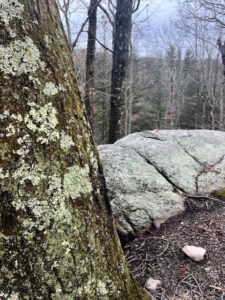
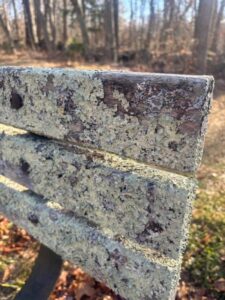
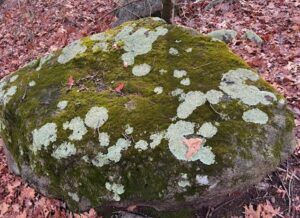
Lichens thrive in diverse habitats throughout the world, from desert to tundra to rainforest to temperate regions, from sea level to mountaintops. They are long-lived and considered keystone species on which other species rely. Their fungal properties recycle nutrients. They provide food for snails, slugs, nematodes, and springtails, which in turn are eaten by birds and other wildlife. Reindeer moss, which is actually a branched lichen, is an important food source for insects, mammals, and birds in alpine and arctic climates.
As lichens absorb water and nutrients directly from the atmosphere, they are susceptible to pollutants such as sulfur dioxide and nitrogen oxides. Therefore, a robust lichen colony is an indicator of clean air and a healthy environment.
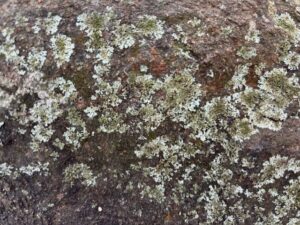
Lichens can be found all over New Canaan Land Trust’s preserves, from granite boulders to stonewalls to tree trunks and boardwalks. Come out and visit this January, take part in our Winter Hike Challenge and explore the wonders of the outdoors.
Thank you, Susan, for this very interesting article about lichen. I knew nothing about lichen, until I read this fascinating piece!