
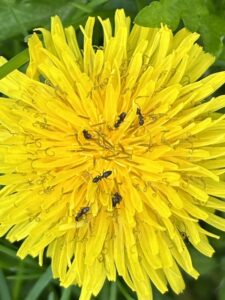
Ants attracted to Dandelion nectar
Ants live everywhere. They thrive in diverse landscapes from fields to forests to bogs to rainforests to deserts. They have adapted to live in the most remote corners of the Earth and in the most crowded urban centers. There are about 14,000 known species of ants and they can be found on every continent except Antarctica.
As a species, ants have been around since the dinosaurs roamed the Earth. They belong to the order Hymenoptera which also includes bees, wasps and sawflies. At some time during the Jurassic period ants diverged from ancient wasps and developed into their own family: Formicidae.
Ants live in hierarchical colonies, similar to that of the honeybee. The colony is dominated by a long-lived queen who lays thousands of eggs. In some species, she may live up to 30 years.
Sterile female workers are responsible for the maintenance of the hive. They tunnel underground to create chambers for the queen’s eggs and developing larvae. They forage for food to feed the young and will fight to defend the nest.
Only a few of the offspring are drones (winged males) whose sole role is to fly out and mate with other queens. They die soon after mating.
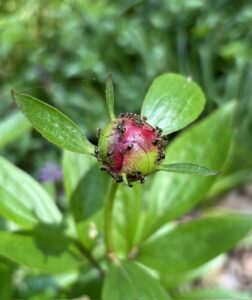
Ants attracted to the sugary sap of a peony bud
Ants are drawn to floral nectar, but are not efficient pollinators as their constant grooming destroys pollen granules. They play many other useful roles in our natural habitats:
- They decompose and recycle all kinds of organic matter
- Their underground tunnels aerate the soil and filter water which is beneficial for the root development of plants
- They aid in seed distribution, especially for spring blooming wildflowers, such as Pussytoes (see photo below).
- They prey on other insect pests, such as fleas, termites and beetles, as well as, insect eggs
- They form mutualistic relationships with specific plants; they ward off pests in exchange for food
- They compose part of the natural food web and are consumed by spiders, assassin bugs and other insects, woodpeckers, wild turkeys, sparrows, wrens, skunks, raccoons, coyotes and even black bears
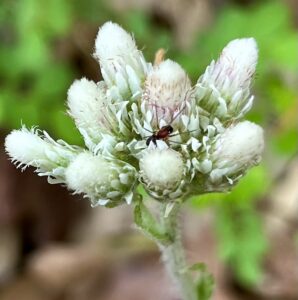
Ants carry Pussytoe seeds back to their nest where they eat the elaiosomes (outer covering) and leave the seeds to germinate
Ants exhibit incredible strength. They can lift 10 to 50 times their body weight due to strong exoskeletons and muscles, as well as, flexible joints. They are small but they are mighty. While we may not want ants to invade our pantries, they help keep the outside world running smoothly.
Recent Comments