
Many native wildflowers bloom in the early spring to take advantage of abundant sunlight before the leaves unfurl on the canopy trees. They harness the sun’s energy to make chlorophyll, to flower and set seeds and fruits. Once their reproductive job is done, they fade away. Some hang on to their green leaves. Others, known as ephemerals, seem to disappear altogether and go dormant until the next spring.
May is a good month to look for wildflowers across NCLT’s preserves. Their bloom time is fleeting and the ‘show’ changes day by day. Here are a few gems to look for and admire.
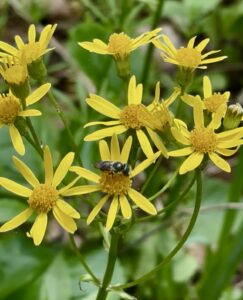
Golden Ragwort (Packera aurea)
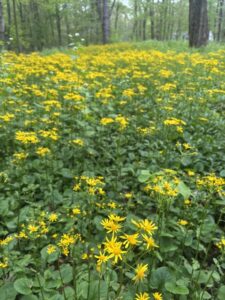
This abundant stand of Golden Ragwort (seen above) was photographed at the Silvermine Fowler meadow. It grows best in moist part shade where it forms a dense groundcover. The bright yellow flowers attract bees and butterflies and the seeds are eaten by birds.
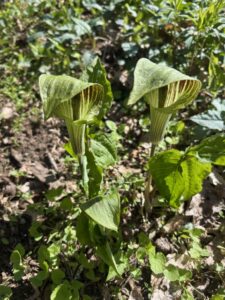
Jack in the Pulpit
(Arisaema triphyllum)
This Jack in the Pulpit was photographed at the Watson-Symington Preserve. Other specimens grow in the woods at Firefly and Colhoun Preserves. The plants, which are either male or female, are cross-pollinated by fungus gnats and small flies. The clusters of bright red berries that develop in late summer and fall appeal to ground-foraging birds, such as wood thrushes and wild turkeys.
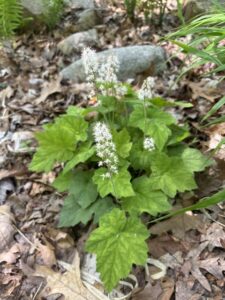
Foamflower (Tirarella cordifolia)
This Foamflower was photographed at the Cam Hutchins Memorial Garden at Bristow Bird Sanctuary. There are several planted at this site as well as in the Barbara Johansen Pollinator Garden at Grupes House. This plant thrives in well-drained soil in sun and part shade. The dainty flowers attract small bees, butterflies, moths and even hummingbirds.
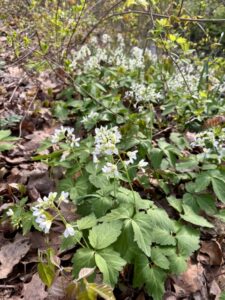
Cutleaf Toothwort
(Cardamine concatenata)
This Cutleaf Toothwort was photographed growing near the footbridge at Bristow Bird Sanctuary. It has divided toothed leaves and delicate clusters of white bell-shaped flowers that are pollinated by native bees and butterflies. This is a true ephemeral with a very short bloom time. By early summer, all traces of the leaves above the ground will have disappeared.
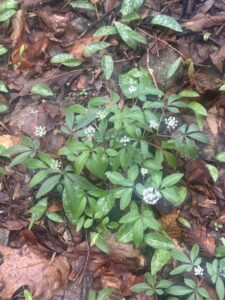
Dwarf Ginseng (Panax trifolius)
This Dwarf Ginseng was photographed at Bristow Bird Sanctuary where it covers a hillside just beyond the gazebo. This diminutive native groundcover grows best in moist shady woods. It has shiny leaves and tiny umbel-shaped white flowers which are pollinated by small native bees and flies.
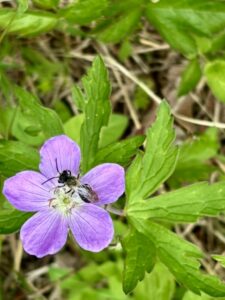
Wild Geranium (Geranium maculatum)
This Wild Geranium was photographed growing in part shade at Hicks Meadow. It can also be found on our other woodland properties, as well as, sunny locations with moist soil. There is a large patch growing in full sun at Hannan-Eberstadt field near the Smith Ridge gate. The pinkish blue flowers attract bees, flower flies, butterflies and moths.

Golden Alexander (Zizia aurea)
There are numerous Golden Alexanders growing along the pathways at Bristow Bird Sanctuary. Several were also planted last fall at the Barbara Johansen Pollinator Garden at Grupes House. Golden Alexander is pollinated by mining bees, flower flies, wasps and beetles and it serves as a host plant for caterpillars of the Black Swallowtail butterfly.
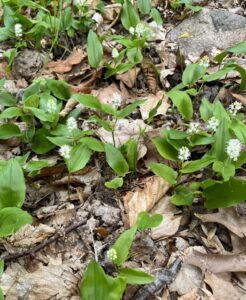
Canada Mayflower
(Maianthemum canadense)
This Canada Mayflower was photographed at Watson-Symington Preserve. It is a common wildflower that carpets the woods throughout our properties all across town. It is sometimes called “False Lily of the Valley.” Two leaves sprouting together are needed to create enough energy for the plant to flower. The tiny white flowers are pollinated by small bees, flower flies and beetles. Small red berries in the fall attract birds and small mammals.
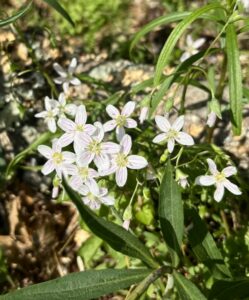
Spring Beauty (Claytonia virginica)
These spring beauties were photographed at Colhoun Preserve. They can be found growing in clumps in partly shaded, moist woods and meadows all over town. Individual flowers only bloom for three days but the plant will continue to produce new blossoms for about three weeks. The white flowers have pink stripes which guide small bees and flower flies to the central source of pollen.
Recent Comments