
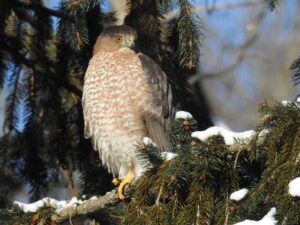
Red-tailed hawk photographed by Avery Stirratt
While the winter world outside our windows may appear to be slumbering, there is still a lot to discover when you venture out. In truth, Nature never rests. Here are some observations made while exploring NCLT’s trails before and after our heavy January snowfall.
January 4th, Blackberry Knot Gall, at the Colhoun Meadow

This blackberry knot gall was spotted clinging to a thorny stalk in the Colhoun meadow. Believe it or not, it is full of living larva of a small wasp species identified as Diastrophus nebulosus. In late summer, the females lay their eggs on the stems of Rubus plants, such as blackberries, raspberries or dewberries. They inject the stems with saliva which causes a knobby gall to grow around and naturally encase the eggs. The wasp saliva also contains enzymes which make the inside fibers of the gall edible and nutritious, thus providing food for their developing larva. After the eggs hatch, the larva live inside the gall protected from predators and winter chill. They will emerge as adult wasps later in the spring.
January 12th, Hakone Grasses, at Bristow Bird Sanctuary
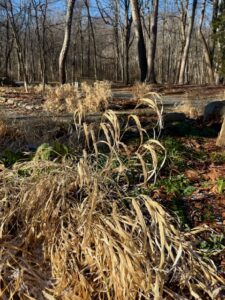
Hakone grasses (Hakonechloa macra) add color, texture and winter interest to woodland landscapes. Though they are not native here, they were chosen to complement the Bristow fern garden due to their hardiness and suitability to thrive in moist shade. They are perennial, require little maintenance and have a sturdy root system that holds soil in place and prevents erosion. They add grace and beauty all year round. Their golden arches are especially stunning in the late afternoon winter sunlight.
January 15th, Tulip Poplar Samaras, at Watson Symington Preserve
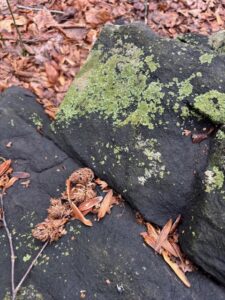
This colorful vignette features vibrant green lichens clinging to dark gray stones and a collection of disassembled tulip poplar samaras. Samaras are cone-shaped seed heads that mature after the flowers fade. Each cone is made of several winged seeds that provide high-energy food for cardinals, chickadees, goldfinches, and many other songbirds, as well as small mammals. These samaras appear to have been collected, stripped of their wings and the seeds eaten in place. It is likely the handiwork of a squirrel or perhaps a white-footed mouse.
January 16th, American Holly, at Silvermine Fowler Meadow
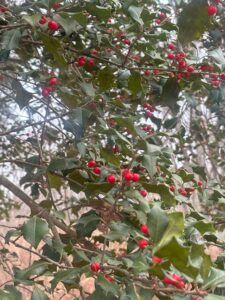
This venerable American Holly stands at the edge of the meadow. It is loaded with berries which are high in fat content providing hungry birds with the energy they need to survive winter when other food is scarce. Many of our winter resident birds, such as cardinals, bluebirds, blue jays, and woodpeckers, relish these berries. From time to time, large flocks of wandering robins and cedar waxwings will descend upon the tree to gorge on its fruits.
January 23rd, Long-stalked Sedge, on The Green Link Trail

At first glance, these green blades peeking out of the snow look like a large clump of grass. However, this is not a grass, but a native perennial sedge called Long-stalked Sedge (Carex pedunculata). It has grasslike foliage with triangular stems and thrives in moist, shady woodlands. This sedge blooms in early spring with inconspicuous flowers that produce seeds encased in a hard protective covering. Propagation is enabled by ants who collect the seeds and eat only the outer shell, thus releasing the inner seed to germinate. This sedge and its attendant ants exemplify symbiotic relationships in Nature, when both plant and animal benefit mutually from their interaction.
January 24th, Brush Pile, at the Firefly Sanctuary

This brush pile near the entrance to the Firefly Preserve on Sleepy Hollow Road may look like a random bunch of discarded wood, but it a vital year-round habitat. It offers sanctuary, shelter and food for birds and mammals, even terrestrial turtles, wood frogs and snakes. The tangle of branches, logs and leaf mulch provides shelter from predators and harsh weather. They create snug roosting spots, places to hole up for the night, safe dens and nesting sites. When spring arrives, Nature’s recyclers (worms, beetles, insects, fungi and an infinite number of microscopic organisms) will work to decompose the pile and eventually return the nutrients to the soil. In the process, they will feed on each other and fuel the rest of the food chain.
January 31st, Tracks in the Snow, at Browne Preserve

Animal tracks in the snow can be difficult to decipher as they may look different depending if the snow’s surface is hard and icy, soft and powdery, or wet. These tracks in the pristine snow at Browne are a little perplexing. At first glance it looks like several animals passed by. On closer inspection, the tracks look like they were made by one animal coming and going with groupings of two long and two short prints. Several people were asked for their opinion and the general consensus is that the tracks belong to a cottontail rabbit. Contrary to popular belief, rabbits do not hibernate. In late fall, they switch their diets from leafy greens to sticks and bark which are available as a food source all winter.
Recent Comments