
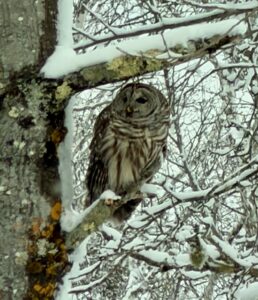
Photo by Avery Stirratt
Barred Owls (Strix varia) are common inhabitants of eastern North America. They thrive in mature woodlands and suburban areas, like New Canaan, which are rapidly becoming reforested. They hunt primarily at dawn and dusk, but are sometimes active during the day. The one above was photographed surveying a backyard on a mid-winter afternoon.
Barred Owls are about the size of a crow. They have a stout body shape, short tails and strong talons which enable them to perch upright on tree branches. Their feathers are a mottled tan, brown and gray in color, and patterned with horizontal stripes on the front of the neck and vertical stripes running down the abdomen. They are easily distinguished from Great Horned Owls as they are smaller, lack the iconic ear tufts and have dark brown, rather than yellow, eyes.

Photo by Avery Stirratt
Like most predators, Barred Owls are opportunistic hunters. Their diet consists primarily of small mammals, such as voles, mice, squirrels and rabbits. If the occasion presents itself, they will also go after songbirds, frogs, salamanders, snakes, fish, crayfish and even bats. Their ears are asymmetrical with one being higher than the other which gives them a keen sense of hearing. They are able to detect small prey rustling under leaves on the ground or beneath the snow.
Barred Owls are secondary cavity nesters. While they raise their young in holes in trees, they do not excavate or build their own nests. They seek existing natural cavities or those carved out by woodpeckers. These usually come lined with soft, decaying wood chips which make a perfect bed for hatching chicks.
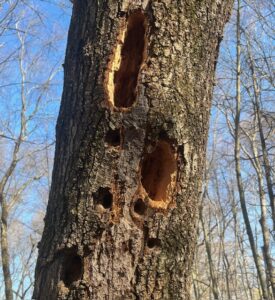
Nesting sites created by woodpeckers at Still Pond
Barred Owls mate for life and often utilize the same nesting site year in and out. They mate in March and females typically lay one to three eggs in April. They do not migrate or move around much. After they establish a home territory, they defend it and seldom leave.
Adults and juveniles exhibit many vocalizations from whistles to hoots to prolonged calls. Their most iconic call is described by birders as “Who cooks for you? Who cooks for you all?” During mating season males and females call in duet to locate one another. The male’s voice is slightly lower in pitch than the female’s voice.
According to Connecticut Audubon Society, Barred Owls are “common, stable and thriving residents throughout Connecticut, having benefited from forest maturation.” While they are not threatened as a species, individuals do fall prey to being poisoned by rodenticide or struck by cars.
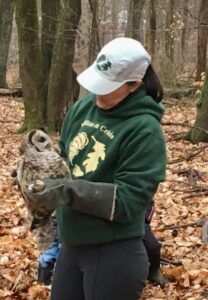
Wildlife In Crisis releasing a Barred Owl
Over the past several years, the Weston-based Wildlife in Crisis has rehabilitated several Barred Owls which were injured in New Canaan. They brought them back to town to be released onto our heavily wooded preserves which offer abundant shelter, nesting sites and prey. If you walk at the Colhoun or Browne Preserve at dusk in late winter, you may be lucky enough to spot one, or at least hear one call.
Recent Comments