
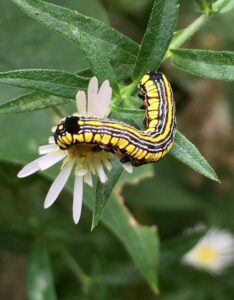
Brown Hooded Owlet Moth Caterpillar on an aster
It’s time to rethink our relationship to caterpillars. There are about 750 species of butterflies in North America and an astounding 12,000 species of moths. All go through a four-phase life cycle from egg to caterpillar to pupa to adult. The adult phase, in which they seek floral nectar for hydration and energy, is relatively short. Butterflies and moths spend a greater portion of their lives in immature phases with their eggs quickly hatching into very hungry caterpillars. Yes, they eat the leaves of our plants but consider the alternative if there were no caterpillars. There would be no butterflies or moths. Without their pollination services, flowers wouldn’t produce as many viable seeds, baby songbirds, who are raised primarily on caterpillars, would starve and the Nature’s food webs would collapse.
Caterpillars have co-evolved with specific host plants. One of the most well- known caterpillar-host plant connection is between Monarch butterflies and milkweeds. While the adults can gather nectar from many different kinds of flowers, their caterpillars can only digest plants in the milkweed family (such as common and swamp milkweed and butterfly weed). In order for a female Monarch to lay her eggs she must locate milkweed in her habitat. If milkweed isn’t available, her offspring won’t survive.
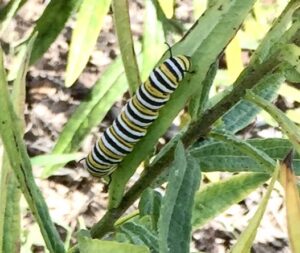
Monarch caterpillar
All butterflies and moths have co-evolved with specific host plants unique to their species. Native plants are key to the survival of caterpillars and therefore butterflies and moths. Canopy trees are particularly important. According to entomologist Doug Tallamy in his book, Bringing Nature Home, native oak trees alone support over 450 species of caterpillars. Significant other native trees that feed caterpillar populations are birches, cherries, cottonwoods, maples, plums, tulip poplars and willows.
Understory trees, perennials, grasses, sedges and legumes also host a variety of caterpillars. Some species are generalists and feed on several different plants, while others are specialists and able to consume only a few. Some example host plant partnerships include: Meadow Fritillaries and violets; Painted Ladies and thistles; and Skippers and grasses, sedges and legumes. Day-flying Hummingbird & Sphinx Moths are generalists and lay their eggs on Arrowwood viburnums, cherries, grapevines, hawthorns, native honeysuckles, plums, snowberries and Virginia creepers.
Below are photos of some common butterflies in New Canaan and their host plants:
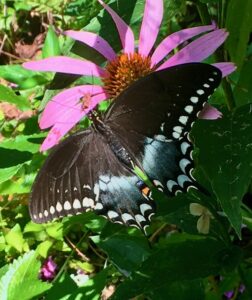
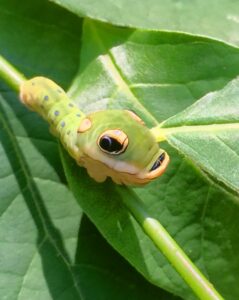
Spicebush Swallowtail caterpillar
Spicebush Swallowtail caterpillars eat spicebush and sassafras leaves.
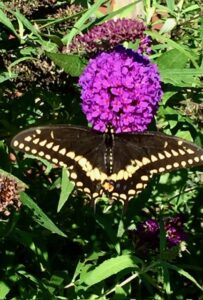
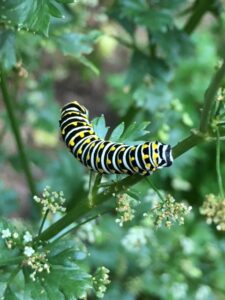
Black Swallowtail caterpillar
Black Swallowtail caterpillars eat plants in the carrot family, including parsley, dill, bronze fennel, Golden Alexander, and Queen Anne’s lace.
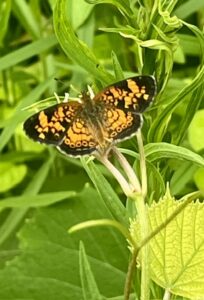
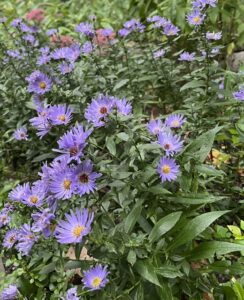
Pearl Crescent caterpillars eat many kinds of asters
One of the challenges to the health of butterfly and moth populations is the introduction of alien species. Our landscapes are full of a multitude off plants that originated in Europe and Asia. Some of them are widely invasive and crowd out native species, while others are nonaggressive. Either way, they do not support our insect populations. Consider the Kousa dogwood, a popular landscape understory tree from Korea. While it is a beautiful and stunning bloomer, it doesn’t support any caterpillars. The native Florida dogwood, on the other hand, hosts Azures and many other species of butterflies and moths.
In addition to host plants, caterpillars need shelter where they can spin their cocoons and pupate. Some attach themselves to twigs and stalks, but many, especially the overwintering ones, bury themselves under the cover of leaf mulch. Therefore, a caterpillar-friendly habitat should include plant stalks left standing all winter and a good amount of leaf mulch left on the ground. The caterpillar pictured below was filmed in September when it was searching for a secluded spot to make a chrysalis and hibernate all winter before morphing into an adult butterfly the following spring.
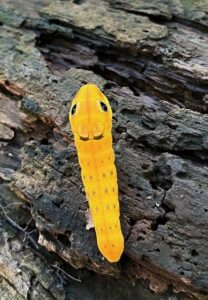
Eastern Tiger Swallowtail caterpillar
Finally, giving caterpillars a break, also means not using pesticides or systemic fertilizers (neoniconitoids) which claim to target pesky bugs but are harmful to all of them.
Want to learn more? Don’t miss “The Extraordinary Caterpillar”, a film by Jeff McKay, featuring Doug Tallamy. Wednesday, June 24th at 1 pm at the New Canaan Library. Sponsored by the New Canaan Pollinator Pathway. To register, go to: newcanaanlibrary.org
Recent Comments