
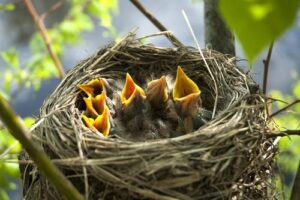
Male robins are full partners when it comes to helping their mates raise their brood. They bring food to the hatchlings and show them how to forage when they fledge the nest. In contrast, tom turkeys don’t help feed their chicks and have little to do with them. Does that make them dead-beat dads? Not at all. Baby birds develop differently. Whether the dad is involved in raising his young depends on whether his babies are altricial or precocial.
Most songbirds are altricial, which means when they hatch: they are naked; their eyes are closed; and they are totally helpless. Altricial chicks depend on both parents to protect the nest and bring in food. After the babies fledge, they still rely on both parents to continue feeding them and to teach them how and where to find food.
Female songbirds lay one egg a day and don’t start incubation until all their eggs are laid (a typical clutch has between 2 and 6 eggs). This ensures that all the eggs will hatch at the same time. Some males occasionally take turns sitting on the nest, but most incubation is the female’s provenance. Songbird eggs typically hatch within 10 to 14 days. Larger birds, such as woodpeckers, may take up to 3 weeks

Turkeys, chickens, ducks and geese are precocial. When they hatch, the babies are fully feathered and open eyed. Within minutes, they are mobile and able to feed themselves. While their mothers keep them warm at night and protect them from predators, the hatchlings are pretty independent from day one. Females in this group also lay their eggs one at a time over a period of 7 to 12 days. The hens don’t start incubation until the last egg is laid. It takes about 28 to 30 days for their eggs to develop. During this time, the males don’t help with incubation and the hens only take short breaks to find food.
While, tom turkeys and roosters have little to do with their offspring, male geese and some ducks will stand guard to protect them from predators.
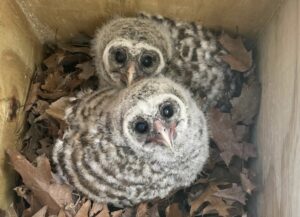
Eagles, hawks and owls are considered semi-altricial. When they hatch their bodies are covered with downy feathers and their eyes are open, however, they are totally dependent on both parents for a long period of time. The females also lay one egg a day but she starts incubating them immediately. The eggs hatch in the order that they are laid which gives the eldest an advantage of size and ability to grab the lion’s share of food.
Eagles incubate their eggs between 35 and 40 days; hawks between 28 and 35 days; and owls between 26-36 days. Moms and dads both bring food for their hatchlings in the nest and teach them how to hunt once they fledge.
It takes a lot of energy, time and dedication to raise a family of baby birds. Some species, known at ‘egg dumpers” avoid the hassle altogether by laying their eggs in other bird’s nests. Brown-headed cowbirds are notorious egg dumpers. Instead of building her own nest, the female deposits an egg or two in the nest of another songbird, such as a yellow warbler, song sparrow, towhee or red-winged blackbird. The unsuspecting ‘host’ birds raise the offspring as their own.
Recent Comments